

The Rule of 55 Guide to Penalty-Free Early Retirement Income
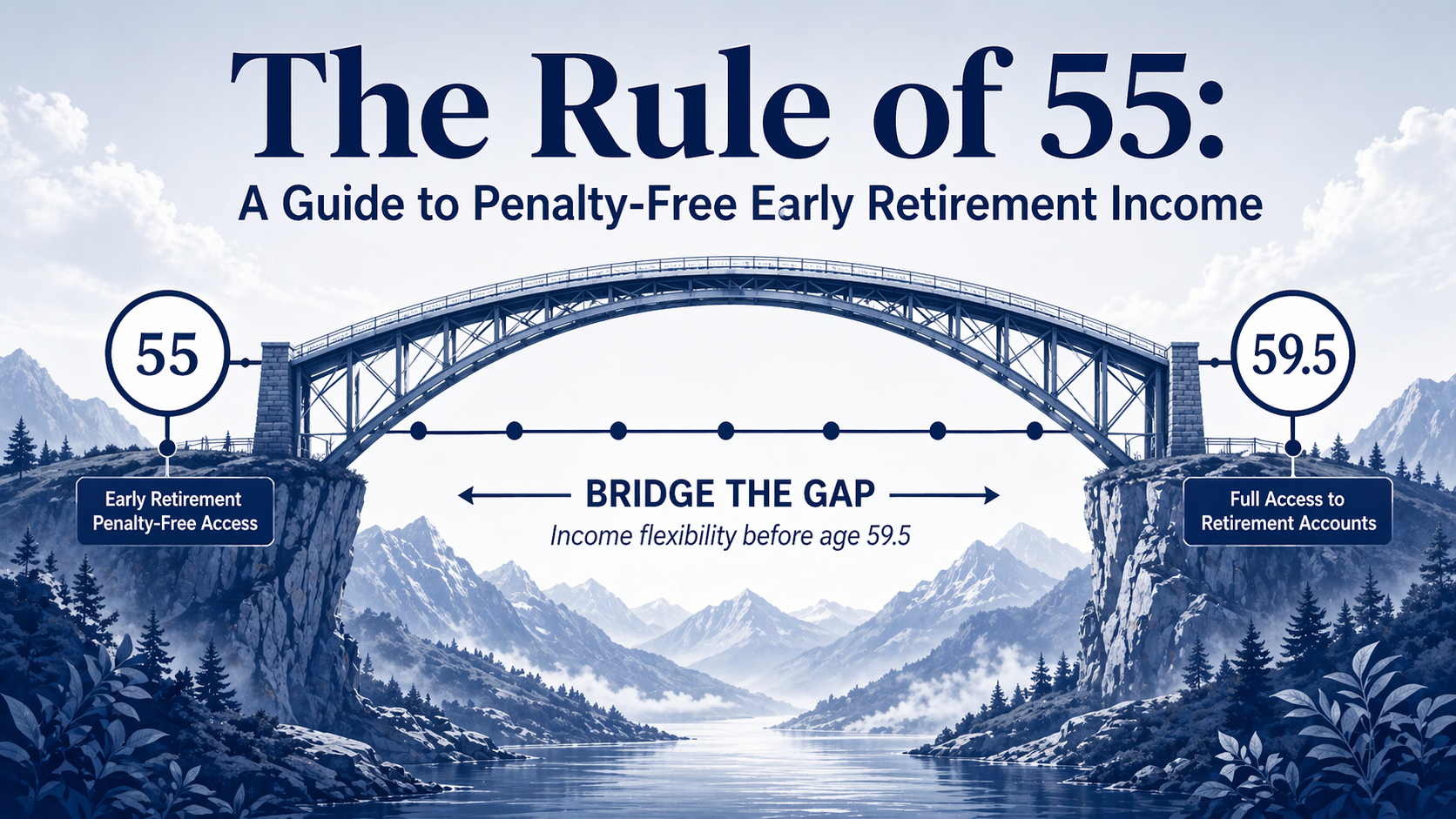
The Rule of 55 is one of the most underused tools available to individuals planning a work-optional lifestyle or early retirement. For someone leaving their employer in their mid-50s, it can create a flexible, penalty-free bridge between your last day of work and age 59.5, when the full menu of retirement account options becomes available.
So if you are looking for answers to questions like…
- What is the Rule of 55, and how does it work?
- How is it different from the standard age 59.5 rule?
- When does the Rule of 55 fit into a broader work-optional plan?
… then this guide is for you!
This guide is to help you understand the Rule of 55 so you can plan retirement income with more flexibility, fewer penalties, and a clearer view of your tax picture.
How the Rule of 55 Works
The Rule of 55 is an IRS provision that allows individuals who separate from service in or after the calendar year they turn age 55 to withdraw funds from that employer’s 401(k) without paying the typical 10% early withdrawal penalty for accessing funds before reaching age 59.5.
The Rule of 55 only applies to the 401(k) or other qualified retirement plan of the employer you most recently separated from. It does not apply to old 401(k)s left at previous employers or to traditional or Roth IRAs.


Rule of 55 vs. Age 59.5 Rule
Most retirement accounts follow the age 59.5 rule. Withdrawals before age 59.5 generally trigger a 10% early withdrawal penalty in addition to ordinary income tax. The age 59.5 rule applies broadly across IRAs, 401(k)s, and other retirement accounts.
The Rule of 55 is an exception specifically for employer-sponsored plans. It creates penalty-free access for retirement funds, but only under specific conditions tied to your most recent employer’s plan and the calendar year you separate from service.
Simply put, the age 59.5 rule is the default. The Rule of 55 is a narrow exception that allows for earlier access of retirement funds for the right person, in the right plan, with the right timing.
Who the Rule of 55 Is Best For
The Rule of 55 can be a powerful strategy, but it’s not for everyone. It tends to work best for individuals who:
Are planning to step away from full-time work before age 59.5. This rule can help bridge the income gap between ages 55 to 59.5 without triggering early withdrawal penalties.
Have a meaningful portion of retirement savings in a current employer’s 401(k). This strategy is most useful when a significant amount of retirement assets are still in an employer-sponsored plan.
Want flexibility before other income sources begin. It can provide a tax-efficient way to generate income while delaying other distributions strategically.
Are planning their exit timing intentionally. Retiring in the wrong calendar year can determine eligibility, even if your 55th birthday is just weeks away. Coordinating the timing of separation is critical.
When the Rule of 55 may not be the right fit
This strategy may be less impactful for individuals who:
Plan to work well into their 60s. They may naturally reach age 59.5 before needing to tap retirement accounts.
Have most assets in IRAs or taxable accounts. Since the rule does not apply to IRAs, other strategies may be more appropriate.
Want to preserve tax-advantaged growth over early access. For those with a long runway before needing retirement income, maximizing tax-deferred growth may outweigh the benefit of early withdrawals.
Conditions for Using the Rule of 55
To use the Rule of 55 effectively, several specific conditions need to line up:
Separation timing: You must separate from service with your employer in or after the calendar year you turn 55.
Current employer’s plan only: The rule applies only to the 401(k) or other qualified retirement plan at the employer you separated from. Old 401(k)s from prior jobs and IRAs are not eligible.
Distributions must occur after separation: The exception only applies to withdrawals taken after you separate from your employer.
Plan distribution rules matter: Some plans restrict how withdrawals can be taken. Confirm your plan’s distribution options before relying on this strategy.
Rolling to an IRA can eliminate eligibility: Once funds are rolled into an IRA, they fall under standard IRA rules and the age 59.5 penalty applies again. Rolling too early is one of the most common ways the Rule of 55 is unintentionally lost.
Ordinary income tax still applies: Penalty-free does not mean tax-free. Withdrawals are taxed as ordinary income in the year you take them.

Interested in working together?
Learn more about our complimentary 4-step process sharing how to minimize taxes, invest smarter, and make work optional. This process is designed to help decide if working together makes sense.
Planning Considerations With the Rule of 55
The Rule of 55 is most useful when it is integrated into a broader plan rather than treated as a standalone decision. A few areas typically deserve attention:
Timing Your Separation From Service
The calendar year matters. If you separate the year that you turn 54, you generally cannot use the Rule of 55, even if you wait until 55 to take a withdrawal. Coordinating your last day of work with the calendar year you turn 55 can preserve eligibility.
Whether to Leave Funds in the 401(k) or Roll to an IRA
IRAs typically offer broader investment options, lower fees, and more flexibility. However, rolling out of the 401(k) generally eliminates eligibility for the Rule of 55 for those funds. A common approach is to leave enough in the 401(k) to cover anticipated income needs until age 59.5 and roll the rest later.
Bridging the Gap Between Early Retirement and Age 59.5
For someone envisioning a work-optional lifestyle at 55 or 56, the Rule of 55 can serve as a bridge to age 59.5, when the full range of retirement withdrawal options becomes available. This bridge is particularly valuable when taxable accounts alone may not fully cover spending needs those early years.
Investment Allocation Inside the 401(k)
When a 401(k) becomes a near-term income source, the investment mix typically deserves a fresh look. Because withdrawals are generally taken pro-rata across your entire account balance, your overall allocation matters more than ever. Keeping the entire account in aggressive growth investments while drawing it down for living expenses increases the risk of selling at unfavorable times. A more balanced allocation before distributions begin can help protect near-term income needs while still allowing remaining assets to grow.
Tax Planning Around Withdrawals
Withdrawals are taxed as ordinary income, so the size and timing of distributions can meaningfully affect your marginal bracket. Spreading withdrawals across calendar years, coordinating with capital gains, and considering Roth conversions in lower-income years are all worth evaluating.
Interaction With Other Income Sources
The Rule of 55 rarely operates in isolation. Severance, taxable brokerage accounts, deferred compensation, and other income sources all interact with your tax picture in the years surrounding separation. Sequencing these thoughtfully typically produces a better outcome than treating each in isolation.
A few questions to help evaluate if the Rule of 55 fits into your plan
Here’s a few helpful questions to decide whether the Rule of 55 fits into your plan:
- Age at separation: Will you separate from service in or after the calendar year you turn 55?
- Plan eligibility: Does your current qualified plan allow partial, periodic withdrawals after separation?
- Asset location: How much of your retirement savings is sitting in the eligible plan compared to IRAs or old 401(k)s?
- Income needs before age 59.5: How much income will you need from retirement accounts before reaching age 59.5 when traditional access opens?
- Tax situation: What other income sources will you have, and how will withdrawals interact with your marginal tax bracket?
- Other resources: Do you have severance, taxable accounts, deferred compensation, or other income sources that could meet short-term spending first?
If most of your answers help point in the right direction, then the Rule of 55 is likely worth a closer look. If they don’t, then other strategies may be a better fit.
How the Rule of 55 Factors as Part of a Broader Financial Plan
Planning for a work-optional lifestyle is generally about flexibility. You want enough resources, in the right account types, available at the right times. The Rule of 55 expands that flexibility by unlocking access to retirement assets earlier than age 59.5, but it works best when it is one piece of a broader plan, not a complete plan on its own.
Here are a few other concepts that help provide flexibility along with the Rule of 55:
Maintain a healthy emergency fund. Even with Rule of 55 access, having cash reserves outside of retirement accounts reduces the pressure to draw down investments during market downturns.
Create a tax-efficient retirement income plan. Determining which accounts to draw from, in what order, and how to rebalance along the way is one of the most impactful decisions in early retirement. There is no one-size-fits-all answer. Drawing first from taxable accounts, then pre-tax, then tax-free is a common starting point, but the right sequence depends on your income sources, tax bracket, and long-term goals. Getting this sequence wrong can cost tens of thousands of dollars in taxes over time. Working with a fiduciary financial planner can help ensure the strategy is executed correctly and tax-efficiently.
Consider taxable savings before retirement. Having a meaningful balance in taxable brokerage accounts gives you flexible, penalty-free access to funds at any age. Combined with pre-tax and Roth accounts, a diversified asset mix across account types generally gives you the most control over your tax picture year by year.
Recognize when the Rule of 55 is less useful. If your 401(k) balance is small relative to your spending needs, your taxable assets are already substantial, or you plan to keep working, then this strategy may not be the right fit for you.
Common Mistakes to Avoid
Here are a few common mistakes to avoid when looking to incorporate the Rule of 55 into your financial plan:
Rolling the 401(k) into an IRA before age 55. This is the most common mistake. Once funds are in an IRA, they generally lose Rule of 55 eligibility.
Assuming all retirement accounts qualify. Old 401(k)s, IRAs, SEP-IRAs, and SIMPLE IRAs do not qualify. Only the plan at the employer you separated from is eligible.
Mistiming the calendar year of separation. Separating before the year you turn age 55 generally disqualifies you from using the Rule of 55.
Overlooking the tax impact of large withdrawals. A penalty-free withdrawal can still push you into a much higher marginal bracket. Spreading distributions across calendar years often produces a better outcome. This is one of the areas where a fiduciary financial planner can help determine a tax-efficient retirement income plan.
Rule of 55 FAQs
1. Does the Rule of 55 apply to IRAs?
No. The Rule of 55 applies only to 401(k) or other qualified retirement plan at the employer you most recently separated from. Traditional and Roth IRAs follow the standard age 59.5 rule.
2. What if I separated from service before the year I turned 55?
In that case, the Rule of 55 generally does not apply. Withdrawals before age 59.5 would typically be subject to the 10% early withdrawal penalty unless another exception applies.
3. Can I use the Rule of 55 with an old 401(k)?
No. The Rule of 55 applies only to the plan at your most recent employer, separated from in or after the year you turned 55. Old 401(k)s from prior jobs are not eligible, even if the balances are larger.
4. Are Rule of 55 withdrawals tax-free?
No. Withdrawals are penalty-free, not tax-free. Distributions from a pre-tax 401(k) are taxed as ordinary income in the year you take them.
5. Can I keep working part-time and still use the Rule of 55?
Yes. Returning to work for a different employer does not affect your ability to take distributions from a former employer’s plan under the Rule of 55. As long as the funds remain in the qualifying plan and are not rolled into an IRA, that eligibility stays intact regardless of your future employment.
One disqualification is if you return to work for the same employer whose plan you are drawing from. Confirm with your plan administrator if that situation arises.
6. What happens if I roll the 401(k) into an IRA?
Funds rolled to an IRA generally lose Rule of 55 eligibility. The age 59.5 rule applies to IRAs, so withdrawals before then would typically face the 10% penalty unless another IRS exception applies.
7. Does the Rule of 55 apply to public safety employees differently?
Yes. Certain qualified public safety employees can generally use the rule starting at age 50 rather than 55, subject to the same plan-specific conditions.
8. How does the Rule of 55 interact with severance or deferred compensation?
Severance and deferred compensation payouts are taxed as ordinary income and can stack on top of any 401(k) withdrawals. Coordinating the timing of these payouts with your Rule of 55 distributions is important to avoid unintentionally pushing yourself into a higher marginal bracket.
More Resources
Financial Planning for Approaching Retirement
The Rule of 55: A Guide to Penalty-Free Early Retirement Income
Retirement Planning Roadmap Guide
Social Security Optimization Guide
Smart Tax Planning Guide
401(k) Rollover Guide
Retirement Planning Case Study
Work Optional Case Study
Mega-Backdoor Roth Guide + Flowchart
Backdoor Roth Guide
RSU Guide + Strategy After Vesting
Deferred Compensation Guide + Case Study
HSA Guide + Strategy for Reimbursement
IRS: Topic no. 558, Additional tax on early distributions from retirement plans other than IRAs
Disclosure: This guide is intended for educational purposes only. The information provided does not constitute tax, legal, or financial advice and should not be relied upon as such. Tax laws and retirement plan rules are subject to change. Please consult a qualified tax professional or fiduciary financial planner regarding your specific situation before taking action.

Safe Landing Financial Newsletter
Sign up for monthly planning insights for tech professionals and pre-retirees!